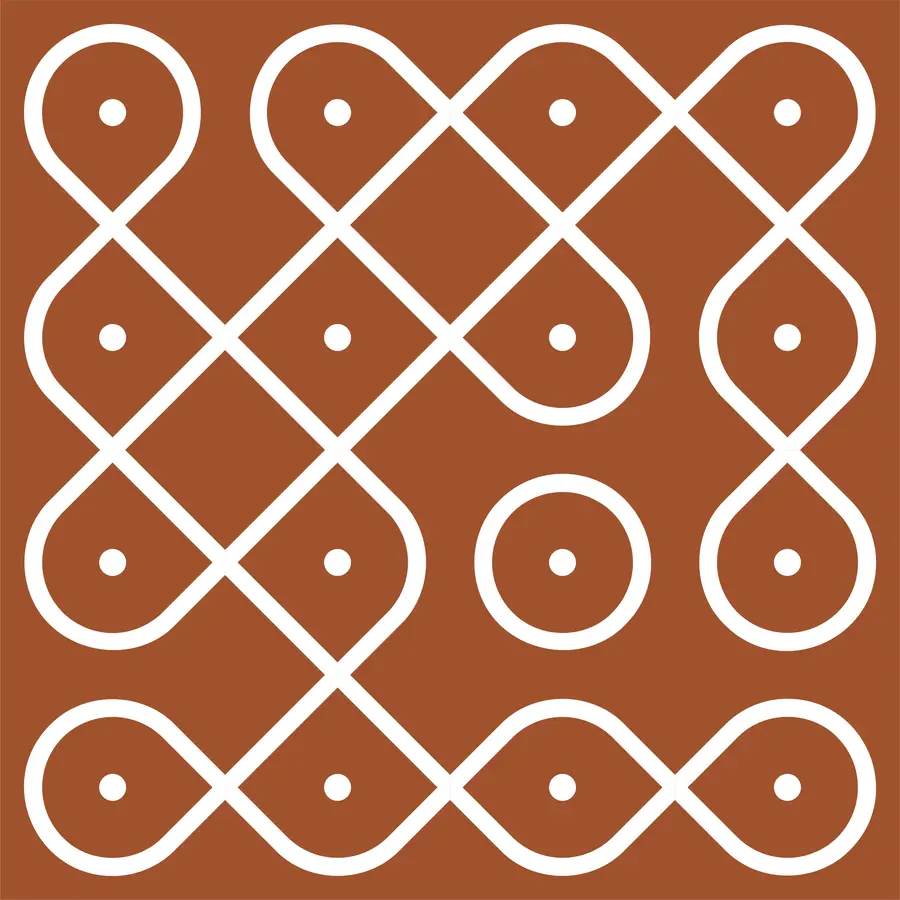
At daybreak, many thresholds in Tamil Nadu become temporary drawing surfaces. The ground is swept, sometimes dampened, and a kōlam is drawn with rice flour, rice paste, or mineral powder. Historically practised and transmitted largely by women, kōlam belongs to the meeting place between home and street: it may be a gesture of welcome, a sign of auspiciousness, a daily discipline, and a work of art intended to disappear beneath footsteps, wind, rain, and time before being made anew.1
Pulli means “dot”. In a pulli kōlam, a grid of dots provides the scaffold from which lines are joined or woven. In the sikku or chikku variety, one or more closed strands loop around the dots, producing patterns that invite questions about symmetry, continuity, topology, algorithms, and counting.
Mathematics is only one way of seeing kōlam. The practice also carries aesthetic, social, ritual, ecological, and personal meanings. We will study one deliberately simplified square-tile model of a sikku kōlam, not a classification of the living tradition. The model keeps a small local grammar visible, turns every rule into an exact condition, and leads to a surprising count.
01
From six shapes to sixteen tiles
Take a square tile and draw a dot at its centre. Now draw a curve around the dot such that it either loops, or exits through midpoints of one or more sides. Ensure that the curve is closed around the dot with segments joining midpoints. There are six of them, and considering orientation, there are sixteen of them.
 1 tile
 4 tiles
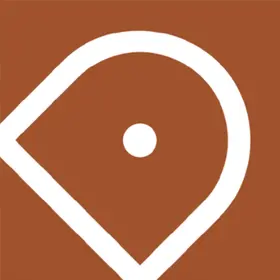 4 tiles
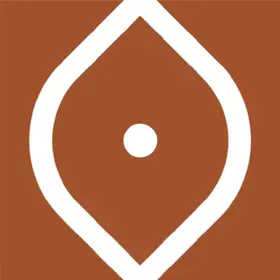 2 tiles
 4 tiles
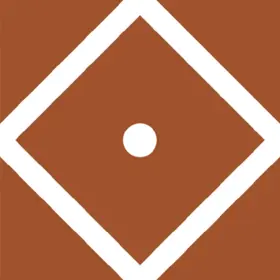 1 tile
1 + 4 + 4 + 2 + 4 + 1=16 oriented tiles
To turn the pictures into mathematical objects, record only one piece of information about each side: does the curve meet the midpoint of that side? Read the sides in the fixed order east, north, west, south, writing 1 for “yes” and 0 for “no”. Each tile therefore receives a binary string of length four. For example, 1011 has exits to the east, west, and south, but not to the north. The label 0000 is not an empty tile: its curve closes inside the square and meets no side.
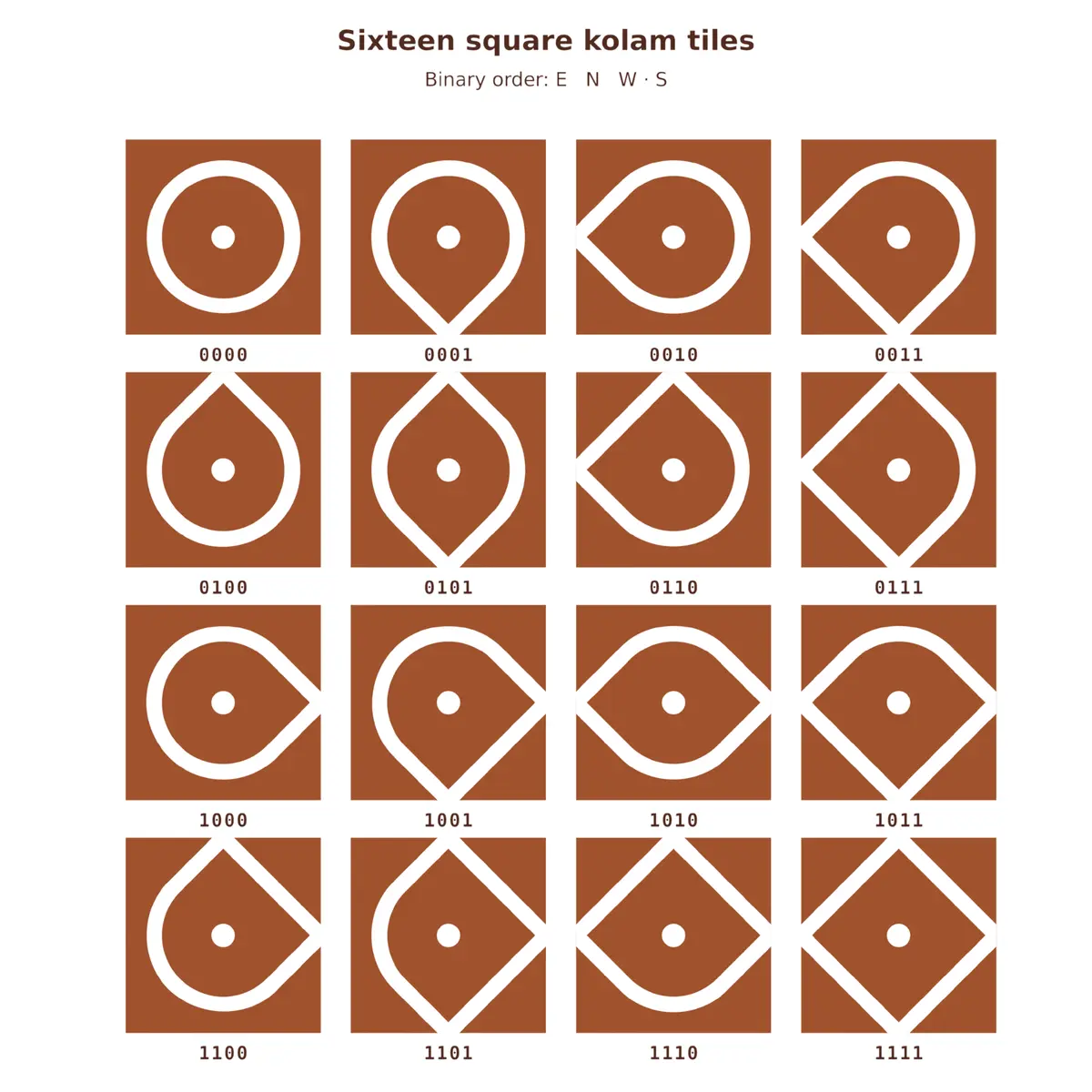
0000 to 1111 in east–north–west–south order.
Can all sixteen tiles make one kolam on a 4 × 4 board?
Use every tile exactly once. Curves must agree across shared sides and may not run out through the outer boundary.
The tile 0000 can never connect to a neighbouring cell, so a one-component board is impossible. We ask instead that it form the one compulsory isolated component and that the other fifteen tiles form a single connected component.
02
Try the puzzle before reading on
Drag the sixteen tiles into the \(4\times4\) frame in the Square Kolam Tile Challenge. The labels are fixed: you may move a tile, but you may not rotate it. Try to make every neighbouring pair agree and keep the fifteen nonzero tiles in one network.
If the embedded puzzle does not load in your browser, use “Open full screen” above.
Hint 1: read the frame as a string of zeros
Every north bit in the top row, south bit in the bottom row, west bit in the left column, and east bit in the right column must be 0. Cross out every position at which one of a tile’s 1s would point out of the square.
Hint 2: use the most constrained positions
A corner has two outward-facing sides. At the top-left corner, both the north and west bits must be 0, so only 0000, 0001, 1000, and 1001 can occur there. Conversely, 1111 cannot lie on the boundary and must occupy one of the four central cells.
Hint 3: build a compatible frontier
Once one row is placed, its four south bits must be exactly the four north bits of the next row. Build row by row, while tracing paths from 1111: a nonzero loop cut off from the unfinished board can never be repaired later.
03
A precise model of the board
We now give names to the board, the tile inventory, and the act of placing a tile. Let
\[ V=\{(x,y):x,y\in\{0,1,2,3\}\}. \]
be the sixteen cells, with \(x\) increasing eastwards and \(y\) increasing southwards. Let \(T=\{0,1\}^4\) be the set of sixteen ENWS words. For \(t\in T\), write \(t_E,t_N,t_W,t_S\) for its four bits. A placement is a function
\[ f:V\longrightarrow T, \]
where \(f(x,y)\) is the globally oriented tile placed in cell \((x,y)\).
A successful board satisfies five precise conditions.
- Exact inventory. The map \(f\) is a bijection: every cell receives one tile and every word in \(T\) occurs exactly once.
- Horizontal matching. For \(0\leq x<3\) and \(0\leq y\leq3\), \[ f(x,y)_E=f(x+1,y)_W. \]
- Vertical matching. For \(0\leq x\leq3\) and \(0\leq y<3\), \[ f(x,y)_S=f(x,y+1)_N. \]
- Closed outer boundary. For every \(x\) and \(y\), \[ f(x,0)_N=f(x,3)_S=f(0,y)_W=f(3,y)_E=0. \]
- Connectivity. Form a graph \(\Gamma_f\) whose vertices are the sixteen cells, joining neighbours when their common matched bits are both 1. If \(z_0=f^{-1}(0000)\), then the subgraph on \(V\setminus\{z_0\}\) must be connected.
Conditions 1–4 define a locally valid exact-inventory board. The fifth says that \(\Gamma_f\) has exactly two components: the compulsory 0000 component and one component containing all fifteen nonzero tiles.
A small invariant with a large consequence
In each of the four bit positions, exactly eight of the sixteen words contain a 1. The complete inventory therefore has 32 exits. Because every exit is paired with exactly one neighbour, every locally valid board has precisely 16 active connections.
After discarding the isolated 0000 vertex, every successful answer is a connected graph with 15 vertices and 16 edges. Its cyclomatic number is therefore \(16-15+1=2\).
04
From a puzzle to satisfiability
A completely unrestricted placement has \(16!=20{,}922{,}789{,}888{,}000\) possibilities. Every condition can be encoded using Boolean variables, while the local rules give us an efficient way to prune the search. For each cell \(v\) and tile \(t\), introduce a variable
\[ X_{v,t}=1\quad\Longleftrightarrow\quad\text{tile }t\text{ occupies cell }v. \]
There are \(16\times16=256\) such variables. The puzzle is now a Boolean satisfiability problem, usually abbreviated to SAT. Bijection gives the “one tile per cell” and “one cell per tile” clauses; matching and boundary conditions forbid incompatible placements. Connectivity is global, so it can be checked afterwards by graph search or encoded with auxiliary reachability variables.
- One tile in every cell. Exactly one of the sixteen statements \(X_{v,t}\) is true for each cell \(v\).
- Every tile used once. For each label \(t\), exactly one cell variable is true.
- Only compatible neighbours. Any pair of labels whose facing bits disagree is forbidden.
- No open boundary. A tile with an outward-facing 1 is forbidden in that position.
- Reach all fifteen tiles. A breadth-first search from the unique
1111tile must visit every nonzero tile.
A general SAT solver can enumerate the answers. For this \(4\times4\) square, a row-by-row search makes the three reported counts particularly transparent.
1,448 horizontally legal rows
Call \(R=(t_0,t_1,t_2,t_3)\) a horizontally legal row when its four labels are distinct, its left and right outer bits are 0, and each pair of facing east–west bits agrees. Testing the \(16\cdot15\cdot14\cdot13=43{,}680\) ordered four-tuples gives exactly 1,448 such rows.
There is also a compact count. Record the five horizontal boundary and interface bits. The two outer bits are fixed at 0, while the three inner bits are free, giving eight paths from 0 back to 0. For each transition, the north and south bits are free; correcting for repeated transitions so that labels remain distinct gives
\[ 24+3\cdot192+2\cdot256+144+192=1{,}448. \]
652 locally valid boards
For each legal row, retain its four north bits, four south bits, and a sixteen-bit mask recording the labels it uses. Stack four rows only when adjacent north–south signatures match, the top and bottom boundary signatures are 0000, and the four masks are disjoint and together contain all sixteen labels. Exactly 652 boards pass those local matching, boundary, and inventory tests. The search is exhaustive because every board has one unique ordered decomposition into four rows.
408 connected nonzero networks
Finally, construct \(\Gamma_f\) for each of the 652 boards and run a breadth-first search from 1111. Exactly 408 searches reach all fifteen nonzero vertices. The other 244 boards obey every local rule but split the nonzero tiles into two or more components.
0000 isolated.Computer-assisted proof
The number 408 is not a sample or a heuristic estimate. The row program checks every possible composition exactly once. A structurally independent cell-by-cell search returns the same 652 and 408 totals.
05
When are two answers really the same?
Suppose you solve the puzzle and then turn the entire sheet through 90 degrees. The picture has changed its position, but not its essential arrangement. The same is true if you reflect the whole square in a mirror.
A square has eight rigid symmetries. Together they form the dihedral group \(D_4\): four rotations and four reflections.
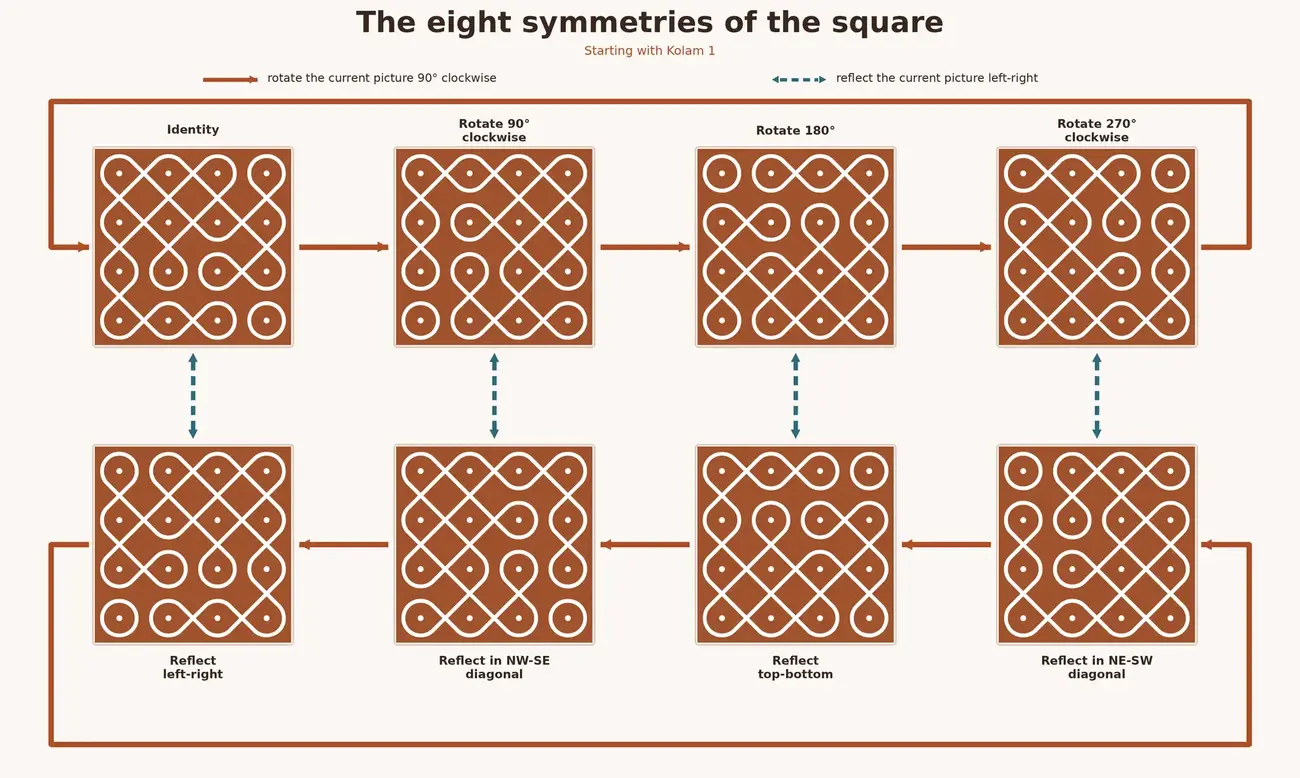
We do not rotate a single tile while placing it. A symmetry moves the completed board as a whole, carrying every compass direction with it. Under a quarter-turn, for example, an east exit becomes a south exit everywhere at once.
The eight images of one board form its orbit. Counting “up to symmetry” means counting these orbits rather than individual labelled boards. But can we simply divide 408 by 8? Only if every orbit really has eight members. A highly symmetric board might have fewer, so we need a theorem that handles this possibility correctly.
06
Burnside’s lemma and the number 51
Let \(X\) be the set of 408 accepted labelled boards. The eight symmetries of the square act on \(X\) by moving a whole completed board. An orbit is the collection of boards obtainable from one another in this way, and our goal is to count these orbits.
Why not immediately divide 408 by 8? A board with its own symmetry could return to itself under more than the identity, making its orbit smaller than eight. Burnside’s lemma corrects for exactly this possibility. For a symmetry \(g\), let \(\operatorname{Fix}(g)\) be the accepted boards that \(g\) leaves unchanged. Then
\[ \#(X/D_4)=\frac{1}{8}\sum_{g\in D_4}|\operatorname{Fix}(g)|. \]
The average comes from a double count. Count pairs \((B,g)\) for which \(g\) fixes \(B\). Counting first by symmetry gives the sum above. If a board is fixed by \(s\) symmetries, its orbit contains \(8/s\) boards, and each is fixed by \(s\) symmetries. Thus every orbit contributes \((8/s)s=8\) pairs. Dividing the total by eight counts the orbits.
In our puzzle, the identity fixes all 408 boards. Both 0000 and 1111 are unchanged by every permutation of the compass directions. A symmetric board must therefore place both labels in cells fixed by the spatial symmetry. On an even \(4\times4\) grid, a nontrivial rotation or a horizontal or vertical reflection has no fixed cell, so none can fix an accepted board.
A diagonal reflection does have four fixed cells, so it needs a final finite check. Each diagonal fixes two locally valid boards, but their component sizes are 9, 3, 3, and 1. None satisfies our connectivity rule.
| Symmetry type | How many | Connected boards fixed | Comment |
|---|---|---|---|
| Identity | 1 | 408 | Every board |
| Quarter-turns | 2 | 0 each | 90° and 270° |
| Half-turn | 1 | 0 | 180° |
| Axis reflections | 2 | 0 each | Horizontal and vertical |
| Diagonal reflections | 2 | 0 each | Fixed candidates are disconnected |
Burnside’s average
There are exactly 51 kolams up to the symmetries of the square.
More precisely: 51 symmetry classes of exact-inventory 4 × 4 boards satisfying the boundary, matching, and two-component conditions. Every class contains eight labelled boards.
Appendix
Reproduce the count or inspect every answer
A finite computer-assisted proof should be inspectable. The companion material records the tile convention, generates all legal boards, checks connectivity, applies the eight square symmetries, and verifies the Burnside ledger independently.
Planned reproducibility companion
The generator and Burnside ledger are planned for the article’s repository folder and have not yet been added.
Open the website repository Catalogue · PDF · 2 pagesSee all 51 completed kolams
One canonical representative from every square-symmetry class, rendered from the exact enumeration.
Open the catalogueWhat does the enumeration do?
build the 1,448 legal four-tile rows
index rows by their north and south signatures
join compatible rows with disjoint tile masks
keep the 652 exact-inventory boards
test reachability from the 1111 tile
keep the 408 accepted boards
replace each D₄ orbit by its least representative
verify: 51 orbits × 8 boards = 408
Notes and further reading
- For the threshold setting, materials, transmission, and cultural meanings of kōlam, see Sahapedia’s “Significance of Kolam in Tamil Culture” and the Indira Gandhi National Centre for the Arts archive note.
- For mathematical approaches, see Marcia Ascher’s “The Kolam Tradition”; Gift Siromoney, Rani Siromoney, and Kamala Krithivasan’s “Array Grammars and Kolam”; and Venkatraman Gopalan’s square-tile sikku-kolam enumeration.
- The exact-inventory puzzle is closely related to edge-matching or Wang-tile problems: local colour matching is replaced here by equality of 0–1 side data.
- Burnside’s lemma is sometimes called the orbit-counting lemma. Its power is that it remains correct even when different objects have orbits of different sizes.
Keywords
Ideas connected in this article
The topic links are reciprocal. In particular, the Burnside’s lemma topic page automatically lists every article tagged with the lemma; when the dedicated exposition is published there, it will already point back to this article.
The code certifies the count; the completed kolams remind us why the objects were worth counting.